A studio for bird study

Tag: drawing

Thoughts on the Past, Present, and Future of the Snowy Plover in North America

by Bryce W. Robinson

Snowy Plover - Charadrius nivosus. 11 x 14 " prismacolor on bristol

Snowy Plover – Charadrius nivosus. 11 x 14 ” prismacolor on bristol. Image copyright Bryce W. Robinson 2015

I’m becoming increasingly fascinated with how our changing world may impact the distribution of a given species, either shifting or fragmenting breeding ranges. I have a particular affinity for the family Charadridae , and I’ve found myself paying closer attention to one species in particular, the Snowy Plover – Charadrius nivosus. The Snowy plover occupies a widespread but disjunct breeding range in its western North American population(Figure 1). This range is likely a result of the bird’s need for specific (in turn limited) habitat for breeding.

Figure 1. Range of Snowy Plover - Charadrius nivosus in North and Central America. Image taken from Birds of North America Online (see referenced information)

Figure 1. Range of Snowy Plover – Charadrius nivosus in North and Central America. Image taken from Birds of North America Online (see referenced information)

The Snowy Plover is a species that has faced many challenges with the ever increasing human presence. Throughout the bird’s North American breeding range (Figure 1), human impacts have caused a multitude of threats to its ability to reproduce. These threats include but are not limited to environmental contaminants, an increase in nest predators such as Raccoon, Common Raven, Coyote, and Red Fox, all of which have experienced a human-subsidized boost in population numbers in recent decades, and recreation on beaches causing both disturbance and nest destruction. A great discussion of all factors impacting Snowy Plover populations can be found on the Birds of North America species account under the Conservation and Management section.

Multiple organizations are working with state and federal wildlife authorities to augment the negative impacts humanity and its residuals are having on Snowy Plover populations. These organizations include Point Blue Conservation ScienceFriends of the Dunes, the National Audubon Society, and many others. The effort is impressive and has seen some success. Still, there is a looming threat on the horizon, the impacts of human induced climatic changes.

What the threats of climate change mean for the Snowy Plover in western North America and across the rest of its range in S. America are still to be determined, but I’d like to emphasize the need to determine and augment these threats as they are occurring. I’ve become aware of a population level analysis that is meant to track the distributional patterns of a given species throughout its yearly cycle (Ruegg et al. 2014). The idea is to identify population structures during the major life events of a species through genetic analysis of individuals at each location; breeding, migration, and non-breeding. Understanding where individuals spend each part of the year holds the power of  identifying where negative impacts are occurring that are driving population declines. This is the big idea behind the banding effort, but this technique provides larger sample size and more power for determining population structures. It’s a huge step in the right direction.

My point is, wouldn’t this be a great tool for assessing changes in populations of the Snowy Plover over its disjunct range as the impacts of climate change become more visible and severe? The answer is yes, and we ought to begin the effort…

Referenced Information:

Page, Gary W., Lynne E. Stenzel, G. W. Page, J. S. Warriner, J. C. Warriner and P. W. Paton. 2009. Snowy Plover (Charadrius nivosus), The Birds of North America Online (A. Poole, Ed.). Ithaca: Cornell Lab of Ornithology; Retrieved from the Birds of North America Online: http://bna.birds.cornell.edu/bna/species/154

Accessed 7 February 2015

Ruegg, K. C., E. C. Anderson, K. L. Paxton, V. Apkenas, S. Lao, R. B. Siegel, D. F. Desante, F. Moore, T. B. Smith. 2014. Mapping migration in a songbird using high-resolution genetic markers. Molecular Ecology 23:5726-5739

Molting Gyrfalcon in Flight

by Bryce W. Robinson

GYRF_Flight

While in Alaska this past summer conducting research on nesting Gyrfalcons – Falco rusticolus, I made many notes and observations concerning the stage of molt for each adult bird that I encountered. I’d like to share a few things that I noticed. I’m still a young student of ornithology, so none of this is new information, just a few interesting things that I noted and count as important information to retain.

First, I was interested to note the difference in stages of molt between male and female Gyrfalcons during the incubation period. The bird I have illustrated above portrays the stage at which most females molt had reached in early to mid May. Males on the other hand had either not initiated molt yet, or had just started. Needless to say, the general trend was that females were farther ahead of males and in some cases were even more advanced than what I have drawn.

Another interesting thing I noted was that this difference in molt stage by sex changed. Once the female began provisioning for nestlings, the females molt slowed as the males caught up.

I set out to illustrate a Gyrfalcon in flight to show some of my observations on molting Gyrfalcons, however creating the digital image of the illustration did not transfer some of the aspects I had hoped it would. One thing I noted concerning the body molt was that the rump was the first to be replaced. All birds in early summer had nice contrasting rumps consisting of fresh feathers. The mantle and scapulars as well as the upper wing coverts had yet to be replaced.

The Gyrfalcons in May were growing in feathers at their initiation points. In Falcons, this is P4 or 5, S4 and 5, the inner tertials, and in the tail the central deck feathers T1. This beginning stage is important for understanding the difference between hawks and falcons, and is another reason I wanted to illustrate a molting falcon

I love studying molt, and in the largest of the falcons it interests me to a great degree. Molt is costly, energetically. When you consider a large species that lives in a harsh climate such as the Arctic, it is remarkable that they complete an entire molt a year, save perhaps a few underwing coverts. Other large avian predators of the region like the Rough-legged Hawk and Golden Eagle do not do this, a fact that makes my respect for the Gyrfalcon grow evermore.

I enjoyed the exercise of drawing this falcon in flight, and adding the aspect of molt to tell a story. I plan to make this a goal of my illustration, to combine creative imagery with context that communicates ideas and facts about the chosen subject. Of course my ability to do so is still a work in progress itself, but as with learning, the process is ultimately satisfying and something I look forward to for the remainder of my life.


Tribute to a Lost Friend

by Caitlin M. Davis

Art by Bryce W. Robinson

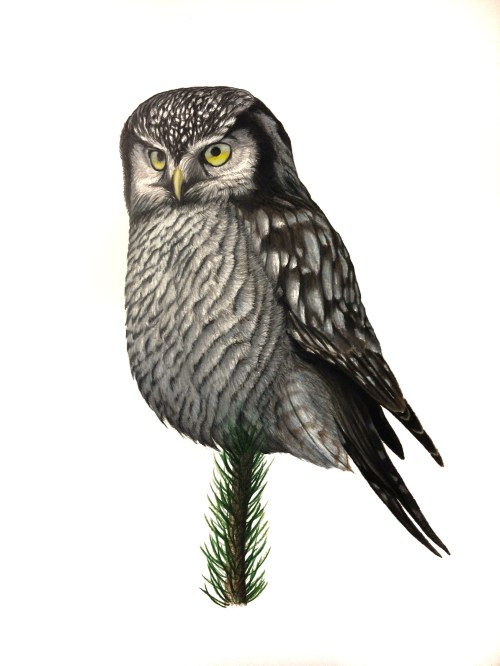
Original Prismacolor Illustration by Bryce W. Robinson

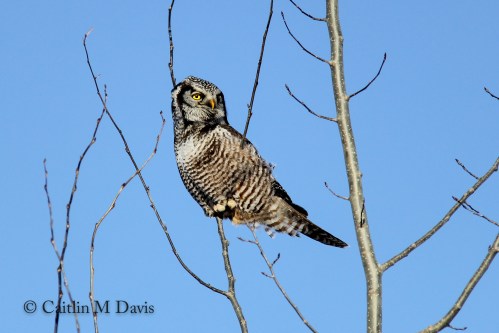
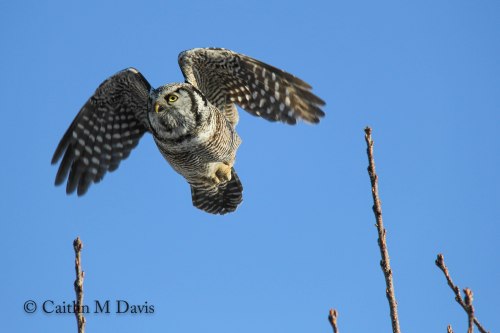
I found out last week that a friend I had met recently died, and I thought it only appropriate to pay tribute. This Northern Hawk Owl, a wanderer from the north, had been hanging out for several weeks at a shopping center in Moscow, Idaho, where he met his tragic fate with a vehicle.

A few weeks ago, Bryce Robinson, Heidi Ware and I made the icy 7 hour trek to see this amazing creature, far away from his home. We were hoping he would give us clues as to why he was lost, and why he had chosen this new city life. Was he dissatisfied with where he lived? Was there no food? Were his parents mean to him? Was he just a dreamy wanderer? Knowing that he is an owl, and probably won’t answer our questions, we were really just excited to spend some time with him.

IMG_1546

We found him within minutes of reaching the shopping center, perched on a telephone wire. He almost immediately dove down and landed in a low tree along a trail next to the road, about 5 feet from a pedestrian. Just imagine a bird you never knew existed, an owl no less, landing in arms reach on your afternoon stroll. A crazy story for even a non-birder. The man made very slow, calculated movements to snap a cell phone picture, while a hoard of birders materialized out of the brush. Everyone, including our cohort, rushed over to see this bird, up close for the first time.

The Hawk Owl was everything we had dreamed of and more! He was extremely docile and tolerant of the barrage of squealing fans and cameras. He just kept with his daily routine, actively looking for prey and  flying from perch to perch. He allowed us to study and enjoy his animated antics for a good amount of time. While we were there he crossed the road and almost got hit by traveling soccer moms, rowdy teenagers and cowboys, multiple times. The owl seemed very content in his new home, so it was only a matter of time before he would meet his inevitable fate.

IMG_1528

It wasn’t surprising to hear the news that he had been hit by a car, but it was quite sad. The drainages next to the road were too full of delicious food and there was cozy, safe infrastructure for roosting. The fact is, even roads hours away from anywhere create a deadly barrier for birds. Raptors are oftentimes drawn to roads because there are comfortable perches and there is ample prey either already dead, or thriving on an endless smorgasbord of waste. They stoop down quickly for a meal and cannot change direction in time to avoid a speeding 18-wheeler.

So, what do we do? This question is important, and I know that research is being done to help ease yet another impact we, humans, have on the world of birds.

Click here to see an adorable clip of this guy if you missed it a few weeks ago.

RIP little buddy.

Illustrating Birds

by Bryce W. Robinson

IMG_0002


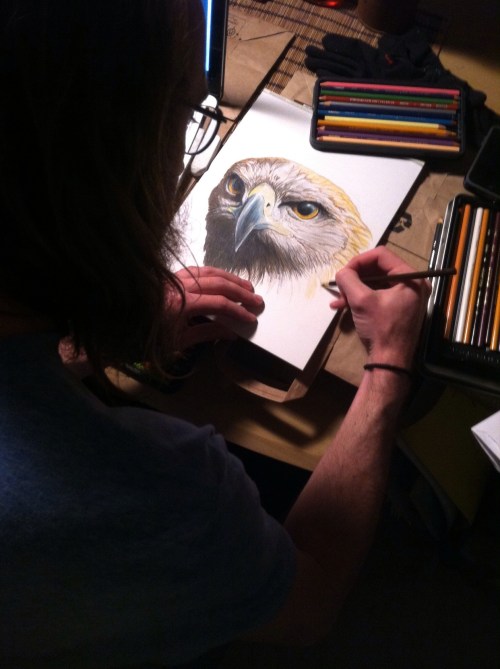
I love the process of illustration nearly as much as I love watching birds. Nothing calms my mind more than putting on some music, drinking a full bottle of wine, and losing myself in the exercise of illustrating an avian subject. I will draw until the day I die.