A studio for bird study

Tag: nest

Using Nest Cameras to Monitor Gyrfalcon Diet

by Bryce W. Robinson

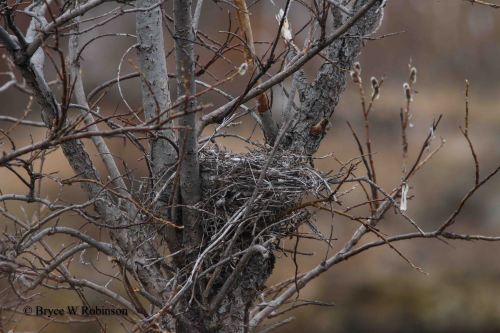
Gyrfalcon Nest with Camera

While I’ve been sharing images and stories from Alaska concerning my work with Gyrfalcons, I’ve neglected to share any aspect of the work that has brought me here. I chose the image above to provide insight into the idea behind The Gyrfalcon Project. In the past month, Neil Paprocki and I have installed 6 motion sensor cameras in Gyrfalcon nests to monitor their diet during the nestling period. This information will give us a better idea of how changes in the system will impact the ability of these birds to reproduce. 6 cameras is a good start for the project, but I am capable of outfitting four more nests with cameras this season. The issue is access, and at the moment I’m scrambling to formulate a plan to put out the final four and round out the season with ten total cameras gathering valuable data of nesting Gyrfalcons. I’ll keep interested readers updated regarding our success. Please feel free to comment about questions, ideas, concerns, or general queries. I’ll do my best to respond when I’m able.  And the Gyrfalcon beat goes on!
The First Gyrfalcon Nestlings

by Bryce W. Robinson

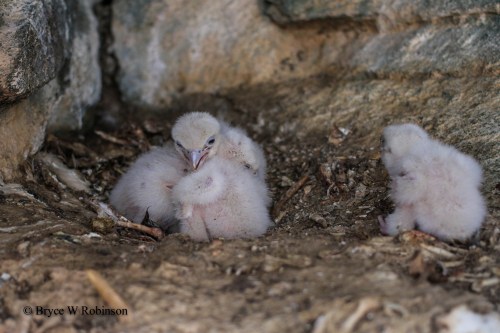
Gyrfalcon Nestlings

I’d like to share this image I was privy to while conducting some work in a Gyrfalcon nest yesterday morning. The earliest nesting Gyrfalcons have young chicks at the moment, which is good news for my study. I remember seeing these four a few weeks ago, when they were just eggs. I’ve seen eggs turn into birds many times, and will again and again, but I’ll always pause in wonder and amazement at the process. And the Gyrfalcon beat goes on…


Northern Shrike Nest in Western Alaska

by Bryce W. Robinson

IMG_7056-2

I’ve been on the ground in Alaska with my friend Neil for a week now, and the hunt for Gyrfalcon nests has been all consuming. We haven’t had much luck on the Gyrfalcon front, most nest sites are occupied by Rough-legged Hawk, Golden Eagle, and Common Raven.

Although we’ve had little success with finding Gyrfalcon nests, we have found many other natural treasures. We’ve already seen our fill of Grizzly Bears, and even caught a brief but close look at a Gray Wolf. It seems that every day in the Alaska bush turns up a number of great experiences. One that tops the list for this past week was when I found a Northern Shrike nest in a small tree along a creekside.

NSHR Nest

The mother held tight in the nest until we were within twenty feet. She then fled, and as we were checking the nest and counting eggs, she came back to her nest. Her responsible behavior and fidelity to her clutch provided me with some great opportunities to photograph her. I appreciate the tenacity of these small passerines. They are truly a vicious song bird. You can see she has some blood on her beak. NSHR

I’ve spent some time at Loggerhead Shrike nests in the desert southwest while doing nesting bird surveys, but I’ve never seen a Northern Shrike nest until now. I’ll tell you, the nests of excubitor are not at all unlike ludovicianus. This nest, like the Loggerhead, was in the middle of the small tree, cones shaped and made of many twigs. The cup was rather deep, and lined with many feathers to insulate eggs and young from the severe weather of the Alaskan tundra. This was a great moment in my first hand education in ornithology, so I had to share.

NSHR Nest wm-0900s


American Golden-Plover- Pluvialis dominica

by Bryce W. Robinson

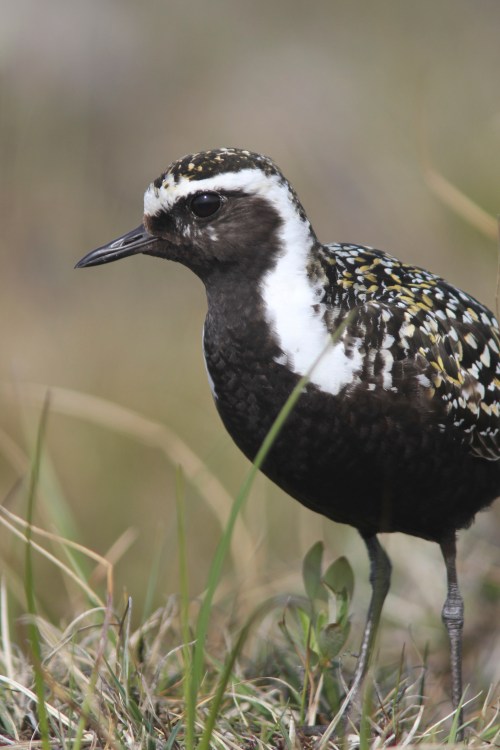
IMG_5677Lately I’ve discussed a problem I have with birds being too close to photograph. This plover has a nest I’ve been monitoring, and each time I visit, the bird does its best to draw attention to itself, and away from the nest. I’ve used this behavior to my advantage for photography, but so often the bird comes too close for the composition I like. My friend Ron, and exceptional photographer, commented on his own experiences, saying that he often embraces this closeness, capturing a headshot. I wanted to share this photo, because I too embraced the birds behaviors, and the result pleases me.

I turned the camera to capture the legs, and hopefully the whole body, but ended up clipping out the back end of the bird. Still, I really like the photograph.

Today, different bird was on the nest. The new bird appeared to be the female. Sadly, close by, the remains of the bird in the above photograph were found. Perhaps, in the line of duty, this bird lost its life distracting a predator from the nest. A sad instance in the life of the American Golden-Plover.