A studio for bird study

Tag: ornithology

Intermountain Bird Observatory’s Long-billed Curlew Study

by Bryce W. Robinson

photo-22

I was fortunate to tag along with Jay Carlisle and the IBO crew yesterday afternoon to trap and outfit a female Long-billed Curlew- Numenius americana, with a GPS transmitter. IBO has been tracking Curlews for a little over a year now, with the focus of understanding their movements and why there has been a general population decline.

This is a great project, headed by a great institution. I encourage everyone to take a moment to learn about the effort and consider supporting the work of IBO.

The Long-billed Curlew is an exceptional bird. Let’s do our part to make sure it has a future in the changing west.

LEARN MORE, and CONTRIBUTE! Do so on IBO’s Curlew Homepage  

Long-billed Curlew nest

Long-billed Curlew nest

Female American Kestrel Illustration- A Symbol to Spread Research and Conservation

by Bryce W. Robinson

Female American Kestrel- Falco sparverius. 11x17" prismacolor on bristol

Female American Kestrel- Falco sparverius. 11×17″ prismacolor on bristol

I’ve been on an American Kestrel binge lately, as I’ve illustrated three birds this winter. I’d like to utilize this binge to promote some great work happening concerning this species here in the western U.S. I illustrated the female Kestrel shown above for one of my peers, Alexandra Anderson, who just completed her master’s project studying the wintering habits of this common falcon. Congratulations on a great project well done Allie.

Here in Boise, Idaho, there is no shortage of research being conducted on our local sparverius population. Dr. Julie Heath at Boise State University has been researching this population for the past 15 years. She has multiple students working on various projects detailing the effects of system change on the kestrel, and for good reason. A recent publication from Dr. Heath’s research reports shorter migration distances resulting in an advancement in timing of nesting due to rises in average winter temperatures (Heath et al. 2012). The game is changing for the kestrel in the west, lets just hope we can understand this change, and how we can manage any negative implications.

The Peregrine Fund, also located here in Boise, has a project devoted to American Kestrel conservation. The American Kestrel Partnership is a network program focused on nest box establishment and rehabilitation to help facilitate a future for this colorful bird. I encourage those interested to get involved by first visiting their website here. On the homepage, you’ll see a revolving screen featuring many incredible Kestrel photos, including images by my friend Mia Mcpherson. She takes amazing photographs of kestrels, and more. Take a look at her website as well.

HawkWatch International in Salt Lake City, Utah has a Kestrel Nest box program, which contributes to The Peregrine Fund’s American Kestrel Partnership, with some added angles. I appreciate HWI, as they involve the public through their citizen science program. Their kestrel project is a great place to get involved, and be a part of an important movement to further our understanding and the future of the colorful and charasmatic American Kestrel.

Literature:

Heath, J. A., K. Steenhof, and M.A. Foster. 2012. Shorter migration distances associated with higher winter temperatures suggest a mechanism for advancing nesting phenology of American Kestrels Falco sparverius. Journal of Avian Biology 43(4) 376-384

Websites:

http://kestrel.peregrinefund.org

http://www.hawkwatch.org/news-and-events/latest-news/405-american-kestrel-citizen-science-project

Home

Possible Red-naped X Red-Breasted Sapsucker Hybird: An Identification Dilemma

by Bryce W. Robinson

Possible RNSA x RBSA

Identifying true hybrids can be mind bending. Attempting to work out the ID can, however, provide a great opportunity to strengthen your knowledge and understanding of distributions and distinguishing characteristics between the species involved.

The bird pictured was reported a few days ago along the Boise River in south west Idaho as a Red-naped Sapsucker, possibly a hybrid with the Red-breasted Sapsucker. This morning, my friends Jay, Heidi, Mitch, and I went in search of the bird to get some photos and see what we thought of its plumage. 

Three Sapsucker species comprise the varius group, including Red-naped (nuchalis),  Red-breasted (ruber and daggetti), and Yellow-bellied (varius), which were all once considered conspecific. Now, each bird is recognized as a distinct species, yet at the confluence of each range, there is regular hybridization. The result is a confusing number of sapsuckers, waiting for the aware and inquisitive birder to work out their identification. 

The Red-breasted Sapsucker breeds on the west side of the Cascade range, continuing north into British Columbia. The area that RBSA and RNSA distributions meet is rather extensive in range, and provides the opportunity for extensive hybridization. It is then very possible for hybridization to occur in British Columbia, with birds migrating into the great basin and ending up in winter in places like Boise. Possible, plausible, but only conjecture.
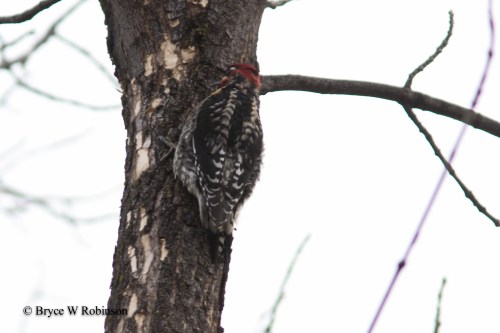
Possible RNSA x RBSA

This bird shows mostly the distinctive features of Red-naped Sapsucker. 

Here is my breakdown of the bird:

1. The back pattern is typical of RNSA, having two distinctive columns of white descending down the back.

2. The lack of red in the breast, and the dark black breast patch is typical of RNSA.

3. The facial pattern and nape are where this bird strays from the typical RNSA, and why I am considering this a possible hybrid. Note the extensive red in the cheek of the bird. It continues from the throat, breaking the white cheek line, and continuing through the white superciliary. To my knowledge, this is not typical for RNSA.

4. Lastly, the black bar on the back of the nape is broken by red. Again, to my knowledge, this is not typical of RNSA.
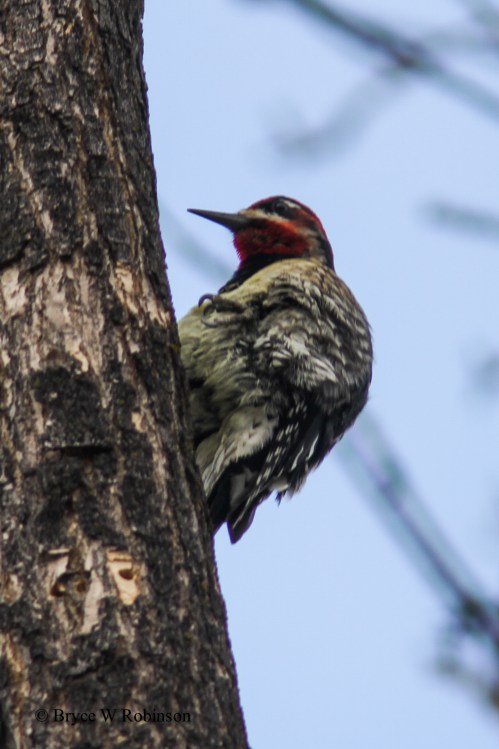
Possible RNSA x RBSA

So, is this a RNSA X RBSA hybrid? Could it be a backcross? Well, I think so, but can’t be sure. It is different, and peaks my curiosity. I’ll certainly be studying the subject more, and looking twice at all sapsuckers I come upon from here forward.

Here is a list of resources I used for this post. I welcome any comments and discussion on this bird.

1. Sapsucker Hybrids by S. Shunk. Birding May/June 2005

2. Hybridization Between Red-breasted (Sphyrapicus rubber) and Red-naped (Sphyrapicus nuchalis) Sapsuckers by J. Garrett 

3. The Sibley Guide to Birds of North America. 2000

 

Female Varied Thrush

by Bryce W. Robinson


This winter, at least two Varied Thrush have taken refuge in a very wild city park in Boise, Idaho. This park, Kathryn Albertson Park, is my go to spot for birding close to home. There have been a great collection of birds there this winter, including White-throated Sparrow, Bewick’s Wren, Evening Grosbeak, Both species of Waxwing, and the list goes on.

I’ve made it a personal goal to strengthen my video archive. Given the regularity of my sightings of both Varied Thrush and White-throated Sparrow, I’ve decided to focus on filming these birds while I have the opportunity.

Filming such secretive skulkers is tough. I’ve spent some time trying, botched multiple opportunities, and ended up empty handed time and again. Yesterday, the active White-throated Sparrow didn’t cooperate as usual, but a female Varied Thrush gave me the opportunity for the clip I’ve been hoping for. Although these clips are short, and at times anticlimactic, they are my goal. My goal is to create an opportunity for birders to get to know particular species a little better through more exposure to their plumage, posture, and behaviors, and re-live some birding moments through those short glimpses that make our day. These clips seem simple, but with most birds a decent video requires loads of persistence, patience, a little skill, and a moment of luck. The end result is so exciting for me, and something I plan to keep working on for the rest of my life.